|
|
| Home I Contact I MRSC |
|
|
| Groupthink | Money Mag: 2024 50 Best Cities | Family Circle: 2014 10 Best Cities |
| Accountability | AI Questions |
|
2026
City of Camas Town Hall on Possible Form of Government Change Real Mayor
Assessment of Councilors/Mayor:
8/3 City of Camas Workshop FOG Discussion, 4:30 pm 7/20 City of Camas Workshop FOG Discussion, 4:30 pm
Council Workshop FOG, 6/7/26 Form of Government Committee Final Report, June 2026 Form of Government Committee June 2026 Report Presentation Slides
2025 Camas Strategic Plan
Lists "Shared Governance" for city employees (pg 25) Implies change of government form needed (pg 25) Main proponents of change are big government people and interests Camas Change of Government Proponents
3/2/26 General Meeting Agenda |
|
AI Questions: In regard to the nonpartisan aspect of Camas elections, what would be the result of eliminating the office of mayor and replacing it with a council appointed manager? In a low-information (council votes non-accessible), nonpartisan city, do organized civic networks become the effective intermediaries between the electorate and government? If so, do special interests become more powerful politically? Regarding the current efforts to change the form of government for the city of Camas, Wa, what are reasons to prefer the political leadership of the current mayor/council/administrator form instead of the professional management inherent in the council/manager/ceremonial mayor form? In Camas, Washington, efforts to change city government from mayor/council/administrator to council/manager/ceremonial mayor are proposed to make city government more like the Camas School District, with its school board and appointed school superintendent. Can a school district governance model meet the needs for city governance? Which Washington State code cities with the council/manager form of government have an elected mayor, that is a mayor not appointed by the council? Answer: Just two, Olympia and Washougal Our City of Camas in Washington State has a mayor/council/administrator form of government, where city ordinance gives extensive delegation of duties to the administrator, but still under the ultimate authority of the mayor. Even with this extensive delegation of duties to the administrator, those opposed to this form of government, and wanting to switch to council/manager/ceremonial mayor, say the the current form is too much work for anyone to handle. Comment on this, as well as what's lost with such a change in regard to any advantages separation of powers has. In Washington State, can a mayor of a mayor/council/administrator city government turn over the running of the city in a nearly complete way to the administrator, with only minimal needed involvement by the elected mayor? Given the usual difficulty in finding city council member votes, being buried in meeting minutes, and making it difficult to hold individual council members accountable by the electorate, does the mayor/council form of government, with its singular CEO mayor, allow for better overall governmental accountability, even if marginally so, when compared with the council/manager form? In non-partisan city council elections, can the usual difficulty in finding city council voting records (because they are buried in meeting minutes), facilitate quasi partisan ways for the electorate to assess candidates? Is the "adapted city" of H. George Frederickson the same the hybrid city government model, two examples of which are mayor/council/administrator or council/manager with an elected ceremonial mayor? Compare the risk of Groupthink between mayor/council and council/manager city governments. |
|
Real Mayor Commentary Current scholarship often highlights the value of blended or hybrid city government forms. An example of such is what Camas has now, a city government that combines management expertise in a professional city administrator, with direct political accountability through an elected CEO (chief executive office) mayor, also called a strong mayor. This CEO mayor together with the mainly legislative council, is much like the separation of powers in our state and federal systems. The stated intent of those proposing the alternate council/manager/ceremonial mayor form of government, is to avert leadership crises by eliminating the CEO mayor, and replace that office with a council appointed city manager. Political leadership goes from a single CEO mayor to a seven member city council. The fundamental issue that makes council/manager/ceremonial mayor the wrong choice for Camas is that it weakens political accountability by eliminating the directly elected CEO mayor and transferring executive authority to an appointed city manager who answers primarily to a seven-member council. And that Camas council, as with most municipalities, already has a dysfunctional political reality: Councilor voting records are buried deep in a multitude of meeting minutes, so that it’s not realistic to expect the electorate, in general, to be informed on counselors and to be able to vote conscientiously, holding them accountable. Note that a CEO mayor though doesn't generally vote on council issues, and thus is elected on the basis of the city's general performance. By removing the CEO mayor, an important check on political power is eliminated, giving all the power to a city council whose votes are practically not assessable to the electorate. That’s a problem that everyone in Camas should be concerned about, and one reason why this government change proposal is wrong for Camas. While both government forms are equally affected by opaque councilor voting records, having separation-of-powers through a CEO performing mayor provides a specific person for the electorate to hold accountable. The ceremonial council/manager mayors have no special powers that give them specific responsibility to hold them to at the ballot box. The solid ouster of council appointed Mayor Shannon Turk in 2019 by a write-in candidate, over the unpopular pool bond (a resolution, not a veto capable ordinance), is an example of a penalty the electorate can impose when the city goes in an unwanted direction. In Camas, the city council has since 1989 delegated operational duties extensively to the administrator, under ultimate mayoral authority, thus making the mayor job easier for potential candidates to consider, which is a key motivation in the effort to change city government. See this ChatGPT explanation. For those who think a governance model similar to school districts would be better for Camas, see this AI consideration.  Groupthink in city governments happens when the city council is unaccountable and isolated. They become invulnerable to electoral control because, in most cities, council member votes are buried in meeting minutes, making informed voting impossible. Instead, voters get information from "quasi-partisan" groups, in the supposedly non-partisan elections. May 4, 2026 example of current Camas City Council dysfunction (video, 24:00 minute mark) |
|
Panel: Camas should govern by council-manager Post/Record June 18, 2026 "Camas should not abandon the current mayor-council, strong-mayor form of government without a compelling demonstration that the existing system is failing, because the evidence shows quite the opposite,” Chaney said. “This hybrid governance model combines professional management with direct voter accountability through the mayor as an elected executive and has served the city well for nearly 40 years." Camas revisits ‘strong council’ Post/Record January 29, 2026 |
|
Real Mayor Commentary June 2026 With council/manager, separation of powers between a mayor and council is lost, and council becomes the only game in town. The manager has no power because they can be fired at any time. The council, now in full control, without any practical accountability, will gleefully push through whatever is their fancy, with Camasonians only along for the taxation ride. No accountability because virtually no one knows how individual council members are voting, because those votes are buried deep in multiple meeting minutes. Add to that the benefit of incumbency, and the entrenched quasi-partisan council members become electorally impervious, which leads to fantasizing groupthink and isolation from community concerns. Council/Manager/Ceremonial Mayor is a bureaucratic take over of city government. |
|
Vancouver City Manager: Lon Pluckhahn Union decries Vancouver police orders not to arrest people suspected of misdemeanors Vancouver has a council/manager government
|
|
Comparable Cities When comparing code cites to Camas on population (20K - 40K) and pre 1970 founding, eleven out of twenty have kept their mayor/council form of government: 2026 Excel Data Here 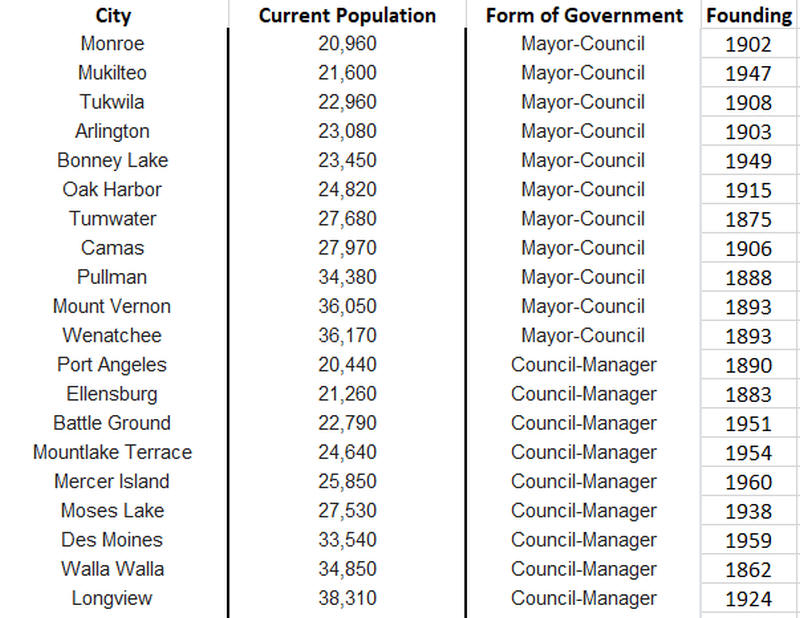 |
|
Council-Caused Pool Debacle Timeline: Resulted in five mayors in three years Jan 2018: Decision to remove Crown Park pool Apr 2018: Government Form Committee report to Council Sept 2018: Mayor Scott Higgins resigns Nov 2018: Shannon Turk appointed Mayor Nov 2019: Barry McDonnell elected Mayor/Prop 2 (Rec Center) Failure May 2021: McDonnell resigns, Ellen Burton appointed Mayor Nov 2021: Steve Hogan elected Mayor |
|
June 4, 2018 Council Agenda Packet
April 16, 2028 Video of Committee
Presentation on City Government Form Government Form Committee Notes (PDF)
|